
Work completed ·
Debugging silicon with an AI agent team
Unexpected sleep current became a shared debug tree. Specialist agents followed the digital and analog branches until simulation and the bench agreed on the culprit.
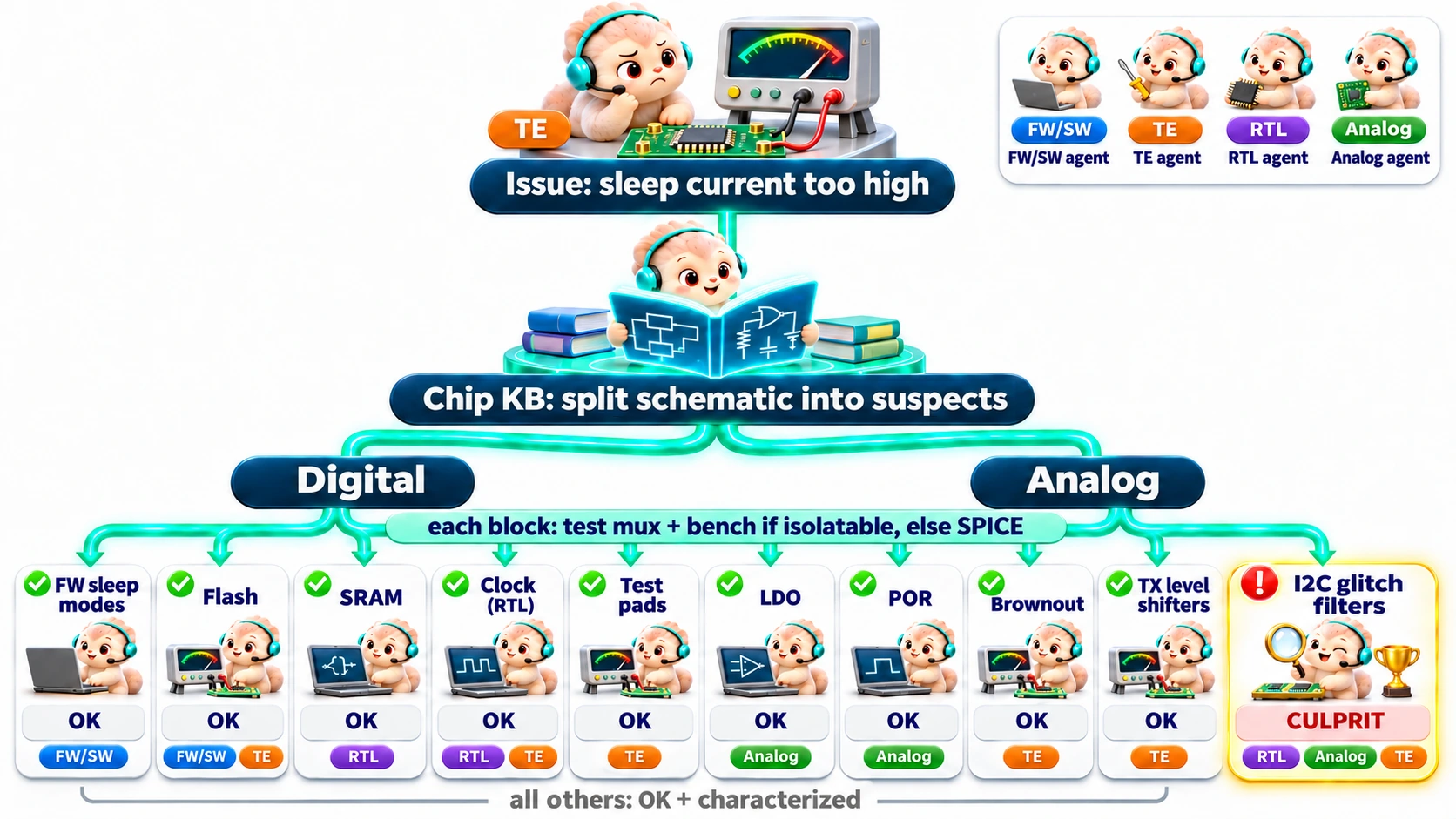
The problem
The new chip drew far more current in sleep than expected on the bench. The TE agent measured the excess; the investigation then followed the supply node through the schematic rather than guessing at a firmware fix.
Follow the tree
The shared chip knowledge base brought schematics, netlists, datasheets and RTL into the same investigation. Suspect blocks became branches that the specialist agents could work through in parallel.
Digital
Firmware sleep modes, Flash, SRAM, the clock tree and test pads. Datasheet checks and logic-analyzer captures tested the memory behavior; clock-speed sweeps showed how much current followed the clock.
Analog
Every block connected to the supply node, including the LDO, power-on reset, brownout circuitry and TX level shifters.
For every suspect, the same rule applied. If the test mux could isolate the block, the TE agent measured it on the bench. Otherwise, the Analog agent simulated it in SPICE on the local laptop.
Who did what
The specialists worked from the same chip knowledge and returned evidence to the same tree.
- FW/SW agent
- Built experiment firmware for sleep-mode checks and the bypass comparison that tested the suspected fault.
- TE agent
- Measured the excess, used the test mux and logic analyzer, swept clock speed with the RTL agent, and confirmed the bypass result on the bench.
- RTL agent
- Investigated the clock tree and inspected the netlist, finding a naming collision in the I²C pad glitch filters.
- Analog agent
- Simulated suspects that the test mux could not isolate, then reproduced the glitch-filter fault in local SPICE.
A naming collision, a physical current path
The RTL agent found net names that differed in letter case but became the same node in a case-insensitive netlist. The glitch filter’s output was shorted to its own input, so the filter constantly fought its driver.
The Analog agent confirmed the mechanism in SPICE. The TE agent compared firmware with the filter bypass enabled and disabled; the bench behavior matched the simulation. The culprit was found the same day the hunt started.
What it changes
Every other suspect block was ruled out and characterized along the way. The result explains the fault and accounts for the whole sleep-current budget.
Search the netlist for names that differ in letter case before a case-insensitive tool can merge them. A shared knowledge base lets firmware, test, RTL and analog agents work the same debug tree in parallel and compare their findings against the hardware.