
The most complicated chip I've designed took the least time to bring up
A digital twin of the chip, built before silicon arrived, let agents run bring-up while the engineer had coffee: one tenth of the previous chip's bring-up time.
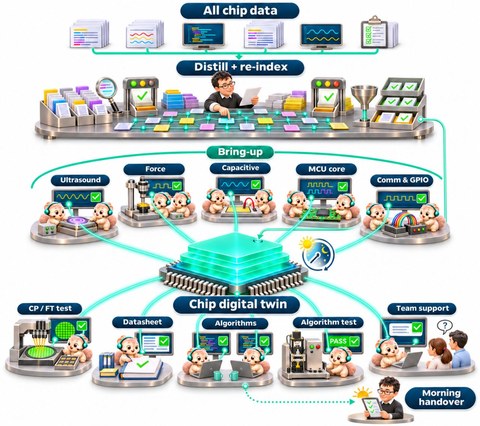
The most complicated chip I've ever designed took the least time to bring up. One tenth of the previous one. Not a typo.
AI is changing the hardware and ASIC world. Drastically. Rapidly.
A few months ago I started to embrace AI, fully, and witnessed an almost 1000% change in work efficiency. I really appreciate the friends who taught me some AI basics, so I started the right way: top down. Build the cross-functional knowledge base (RAG) first, before building any agents.
In our case, I built a digital twin of the chip before the chip even arrived. Now you say "bring up this feature", "char this AFE", "debug this communication issue", and you watch the agents query the KB, get the answer and move on, while you're having your coffee.
Answering all those questions about the chip used to take 100% of my time. Now the digital twin acts as me, the agents do the work, and I'm still having my coffee.
Right now I have 10 bench setups running like this, all at the same time. What an amazing world.
(Of course, there's an important "but": you have to build your RAG well, and it is not easy.)
Even the datasheet is generated from the knowledge base, and it reads better than when I wrote it by hand. A few months from now I'd be surprised if anyone is still handwriting datasheets.
AI has changed 95% of my work, and maybe 70% of my lifestyle. I only wish I started earlier.
One year from today, what will the hardware industry look like? Really looking forward to it.
More to come and more to share. Happy to chat if you're interested.
First posted on LinkedIn, November 17, 2026.